There is a limit on how many tests one assessment can hold, and the builder shows it. You will almost never want to get near it.
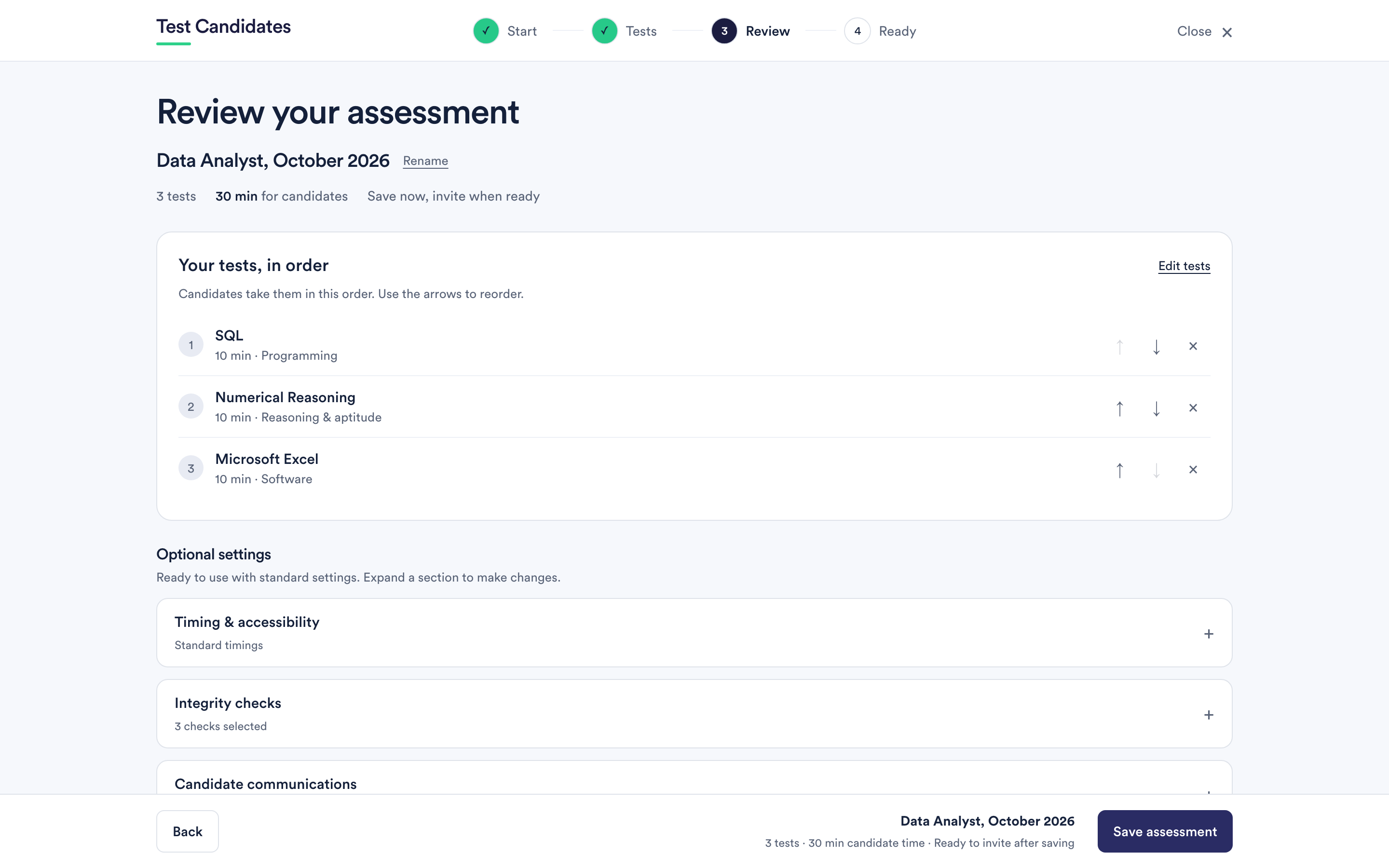
The trade-off between evidence and drop-out
Every test you add buys you one more piece of evidence and costs you candidates. The cost is not evenly spread: the people most likely to abandon a long assessment are the ones with other offers, which is not the group you want to lose.
The builder shows the candidate time total as you select. That number, not the number of tests, is what candidates react to.
A way of deciding
For each test you are considering, answer one question: what decision would I make differently if this score came back low?
If you can answer it, keep the test. If you cannot, you are collecting a number you will not act on, and the candidate is sitting it for nothing.
That usually leaves a short list:
- One test for the core skill the role runs on.
- One test for the reasoning the role demands, if it demands any.
- One for how the person works, where that genuinely matters to the job.
Do not measure the same thing twice
Two reasoning tests that overlap heavily give you one piece of evidence and charge the candidate twice for it. Each test's guide has a section on choosing other tests, which names what it pairs well with and what it duplicates.
Length and the clock
Most timed tests in the library run to a similar length, so the total is roughly the number of timed tests times that length. Personality and drives questionnaires have no clock at all, and candidates take as long as they take.
If you have set extra time for everyone, the timed part grows by the percentage you chose. See timing, extra time and adjustments.
One charge either way
A candidate counts once however many tests are in their assessment, so a longer assessment does not cost you more. The cost of length is drop-out, not money. See when a candidate is charged.