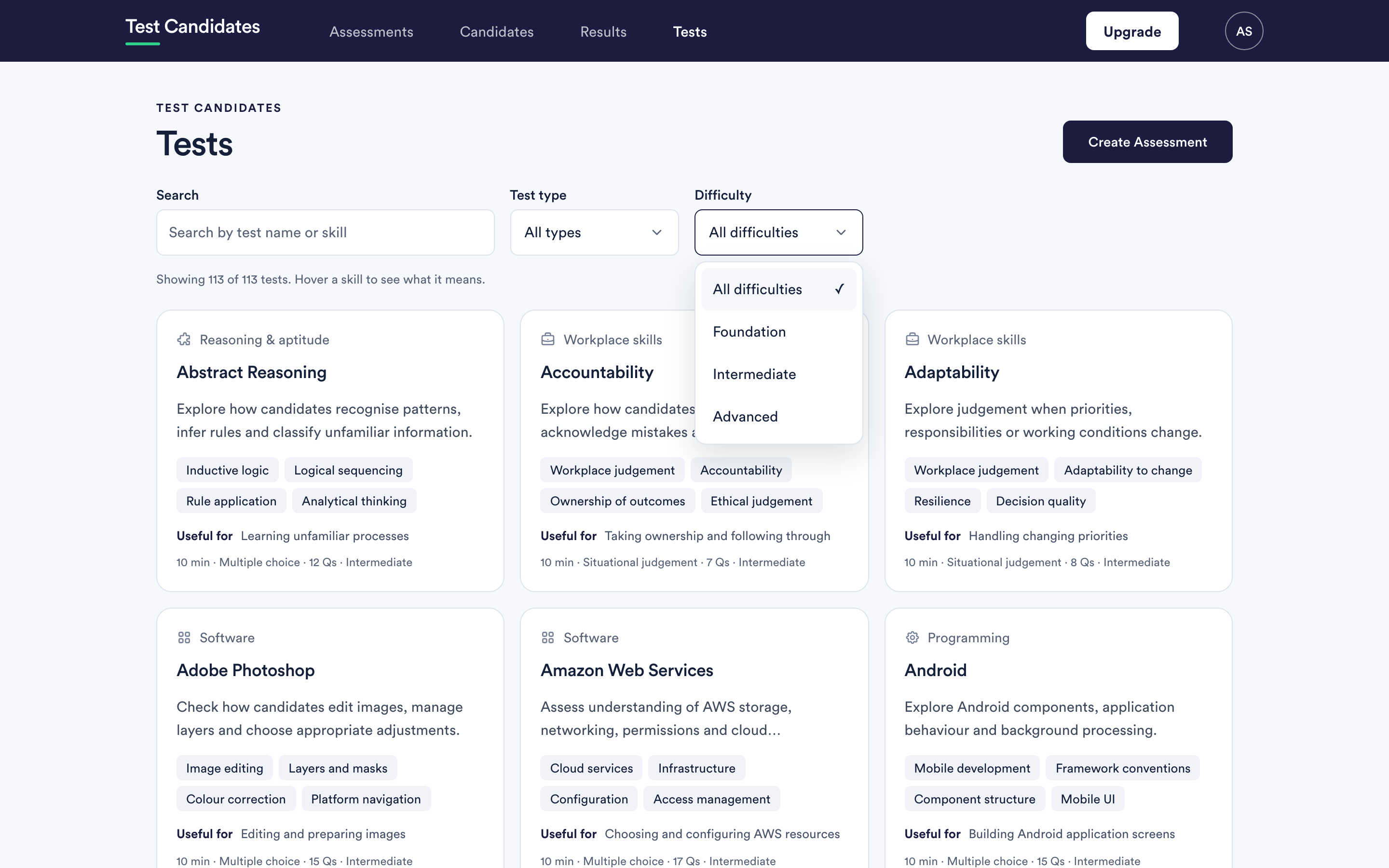
Some tests come at more than one level. Where they do, the level is part of the test rather than a setting you change afterwards: you choose Verbal Reasoning (Foundation) or Verbal Reasoning (Advanced) when you build the assessment.
What the three levels mean
Foundation. The candidate applies a single clear rule or reads information directly from what is in front of them.
Intermediate. The candidate has to work out a relationship and apply it, often comparing more than one possible rule before answering.
Advanced. More steps, more information to hold at once, and less of the structure given to them.
What a level is not
It is not calibrated against candidate scores. The label describes how complex the task is, in the judgement of the people who wrote the test. It is not derived from how hard candidates found it, and it does not carry a pass standard.
It is also not a seniority requirement. Advanced does not mean "for senior roles" and Foundation does not mean "for junior ones". A senior role that mostly applies well-understood rules quickly may be better measured by a Foundation test with a clock on it.
How to choose a level
Start from the work, not the job title. Ask what the role actually requires someone to do with information:
- Read it and act on it correctly → Foundation.
- Work out what is going on and apply it → Intermediate.
- Hold several things at once and reason through them → Advanced.
If you are hiring at volume and want a spread you can rank, Intermediate usually separates candidates best. A test too easy for the group bunches everyone at the top and tells you nothing; a test too hard bunches everyone at the bottom and tells you nothing either.
If you are unsure
Pick Intermediate and read the distribution on your first dozen candidates. If almost everyone is at one end, change the level for the next round. See scores, averages and rank.
Mixing levels in one assessment
You can, and it is sometimes right: an Advanced test in the skill the role lives or dies by, and Foundation elsewhere. What you should not do is set everything to Advanced to make the assessment feel rigorous. It lengthens the assessment, loses candidates, and gives you a flatter set of scores.