Three numbers do most of the work in a report, and they mean different things.
What the score is
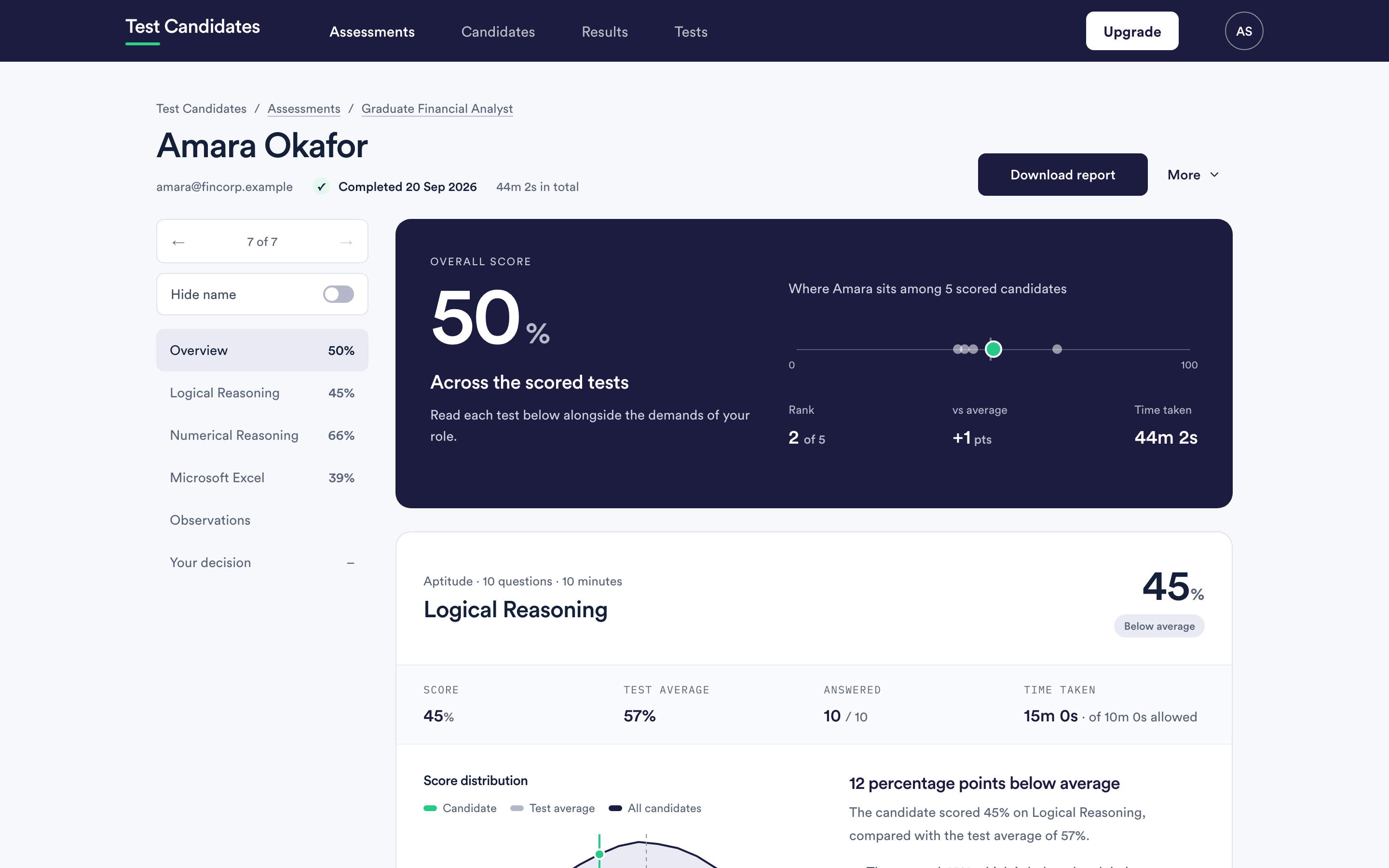
A percentage of the questions the candidate got right on that test. That is all it is. It is not scaled, not curved and not adjusted for difficulty.
Because of that, scores are not comparable across different tests. Sixty per cent on a Foundation test and sixty per cent on an Advanced test are not the same achievement, and neither is sixty per cent on a twelve-question test and a forty-question one.
The test average
Library tests show an average across everyone who has taken that test with us, not just your candidates. It is the closest thing to an outside reference point you get, and it is what the grey marker shows on the comparison view.
Custom tests you wrote yourself have no average, because nobody outside your account has taken them.
Rank, and versus average
These are calculated within one assessment: the other people who took the same tests for the same job.
That is the comparison that usually matters. You are not choosing between your candidate and the world, you are choosing between the people who applied.
Two consequences worth holding on to:
- Rank moves. A candidate who was second of five can be fifth of twenty a fortnight later. Nothing about them changed.
- Small cohorts say little. Being top of four is a fact about four people. The report shows how many scored candidates the rank is out of; read it.
Percentiles
Aptitude and skills tests do not report percentiles. Personality traits do, and a percentile there describes where a candidate sits on that trait relative to the comparison group, not how well they did. See interpret personality results.
There is no pass mark
We do not set one and we do not recommend one. If you want a threshold, set it deliberately, write it down before you look at any candidate, and apply it to everyone. A threshold chosen after seeing the scores is a rationalisation.
Reading a distribution
If nearly all your candidates cluster at one end, the test is the wrong difficulty for this group and is not separating anyone. Change the level on the next round rather than reading meaning into a narrow spread. See difficulty levels and how to pick one.
The other half of the evidence
A score tells you the outcome. The every answer in order chart tells you how they got there, and it is often the part that changes your mind.