Drives is about motivation: what a candidate wants from work at this point in their career. Like personality, it is not scored and does not enter the overall score.
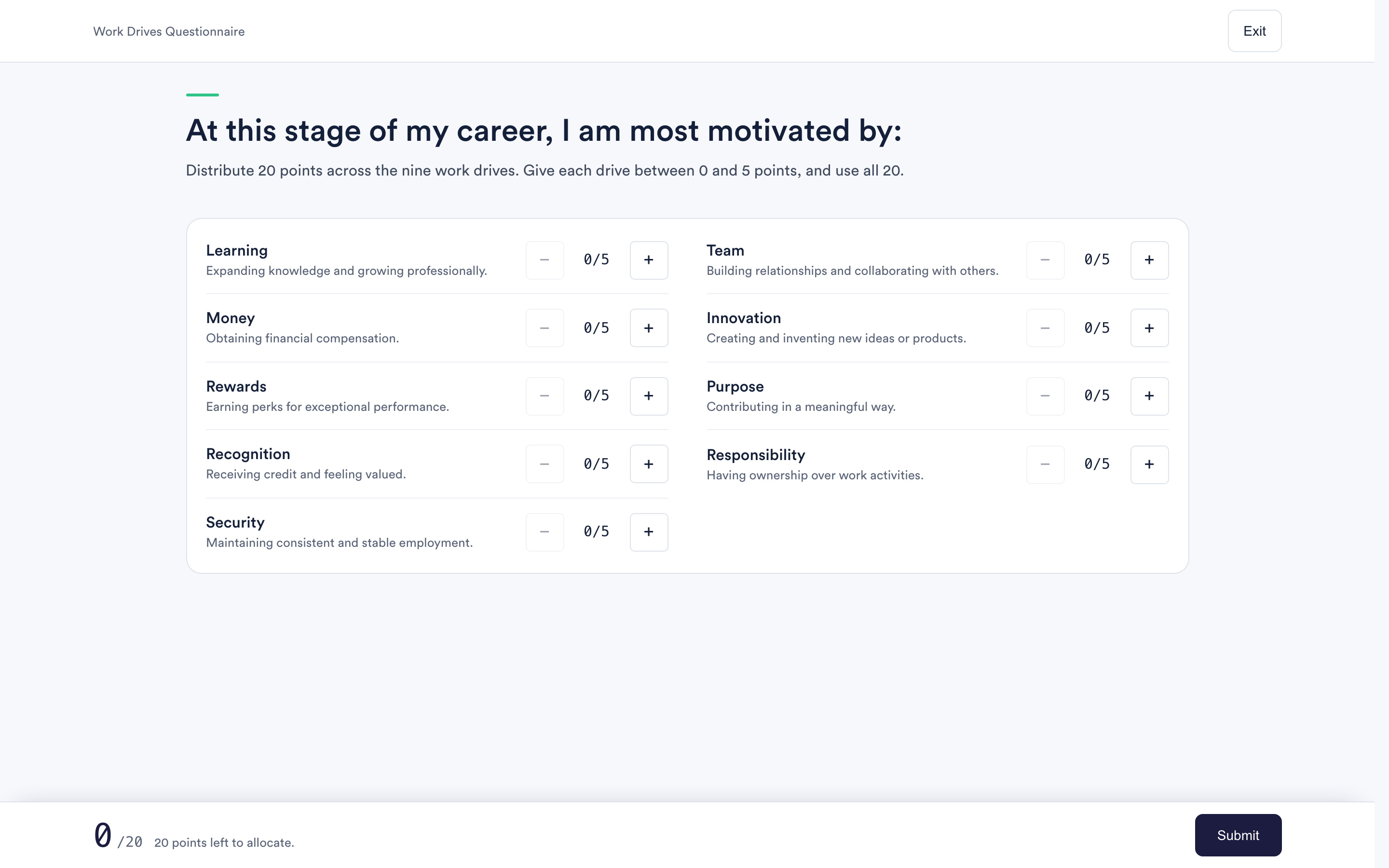
How candidates answer the drives questionnaire
Candidates are given a fixed pool of points and asked to distribute them across the drives that motivate them most. It is a short, untimed exercise.
Why that changes how you read the result
Because the total is fixed, the scores are relative to each other, not absolute. A candidate cannot say that everything matters a lot. Giving more to one drive necessarily means giving less to another.
So the useful reading is the shape: which two or three drives took most of the points, and which got none. A low score does not mean the candidate does not care about that thing, only that they cared about something else more when forced to choose.
Comparing one candidate's score on a single drive against another's is the least informative thing you can do with it.
What drives results are good for
Retention and fit conversations. If the role's strongest offer is autonomy and a candidate put their points on structure and progression, that is worth discussing before an offer rather than in an exit interview.
Honesty about the job. It is a reasonable prompt for describing the role as it actually is. Candidates who know what they are taking on stay longer.
What drives results are not for
It is not a filter. There is no right profile for a job and no wrong one. Declining a candidate because of how they distributed points is very hard to justify, to them or to anyone else.
It is not fixed. It captures what someone wants now. People's motivations change with circumstances, and the questionnaire asks about this point in their career on purpose.
Talking about drives with a candidate
It reads well in conversation because candidates recognise themselves in it. "You put a lot of weight on variety; tell me about a job that had too little of it" is a good question. Presenting it as a verdict is not.