The cognitive ability tests are the ones most people mean when they say "aptitude test". They are timed and multiple choice. They measure how someone works with information they have not seen before.
What the cognitive ability range covers
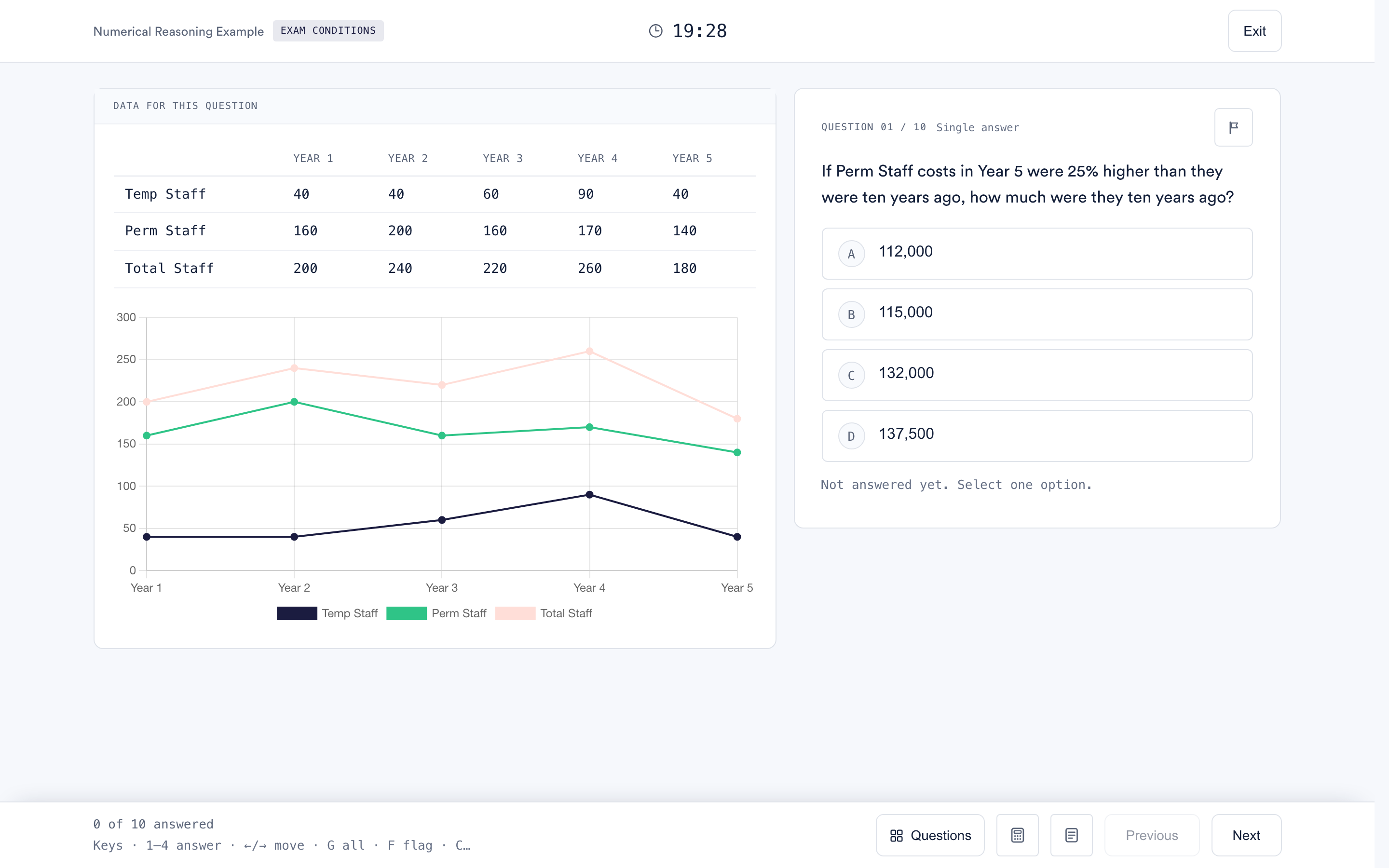
- Numerical reasoning. Reading figures in tables and charts and working something out from them. For roles that handle numbers in the ordinary course of the job.
- Verbal reasoning. Drawing what does and does not follow from a passage of text. For roles where misreading a document is expensive.
- Logical, inductive and deductive reasoning. Working out a rule and applying it. For roles that meet unfamiliar processes.
- Abstract, diagrammatic and spatial reasoning. The same, with shapes and patterns instead of words and numbers.
- Mechanical reasoning. Everyday physical principles: forces, gears, levers, circuits.
- Error checking. Spotting differences between records, at speed.
- Basic maths. Straightforward arithmetic rather than reasoning.
- Cognitive ability. A single test that combines verbal, numerical and abstract reasoning.
Several exist at Foundation, Intermediate and Advanced. See difficulty levels and how to pick one.
Choosing between reasoning tests
Start from what the role actually does with information:
| The job involves | Consider |
|---|---|
| Budgets, pricing, reports with figures | Numerical reasoning |
| Contracts, policies, long documents | Verbal reasoning |
| Learning unfamiliar systems and processes | Logical or inductive reasoning |
| Checking records, data entry, compliance | Error checking |
| Plant, machinery, physical equipment | Mechanical reasoning |
One of these tests is usually enough. Two that overlap give you one piece of evidence and cost the candidate twice.
Reading a score
A percentage of questions answered correctly, under a clock. It is not scaled for difficulty, so scores are not comparable between one test and another. See scores, averages and rank.
The every answer in order chart is especially useful here, because it separates "did not know" from "ran out of time".
What a reasoning score does not establish
A reasoning score does not establish technical competence, communication, creativity or likely job performance. It is evidence about one thing, and the test's own guide says so in those words.
What candidates are told
Each of these has a plain-English explanation in the candidate help centre, so you can point people at it. For example numerical reasoning.