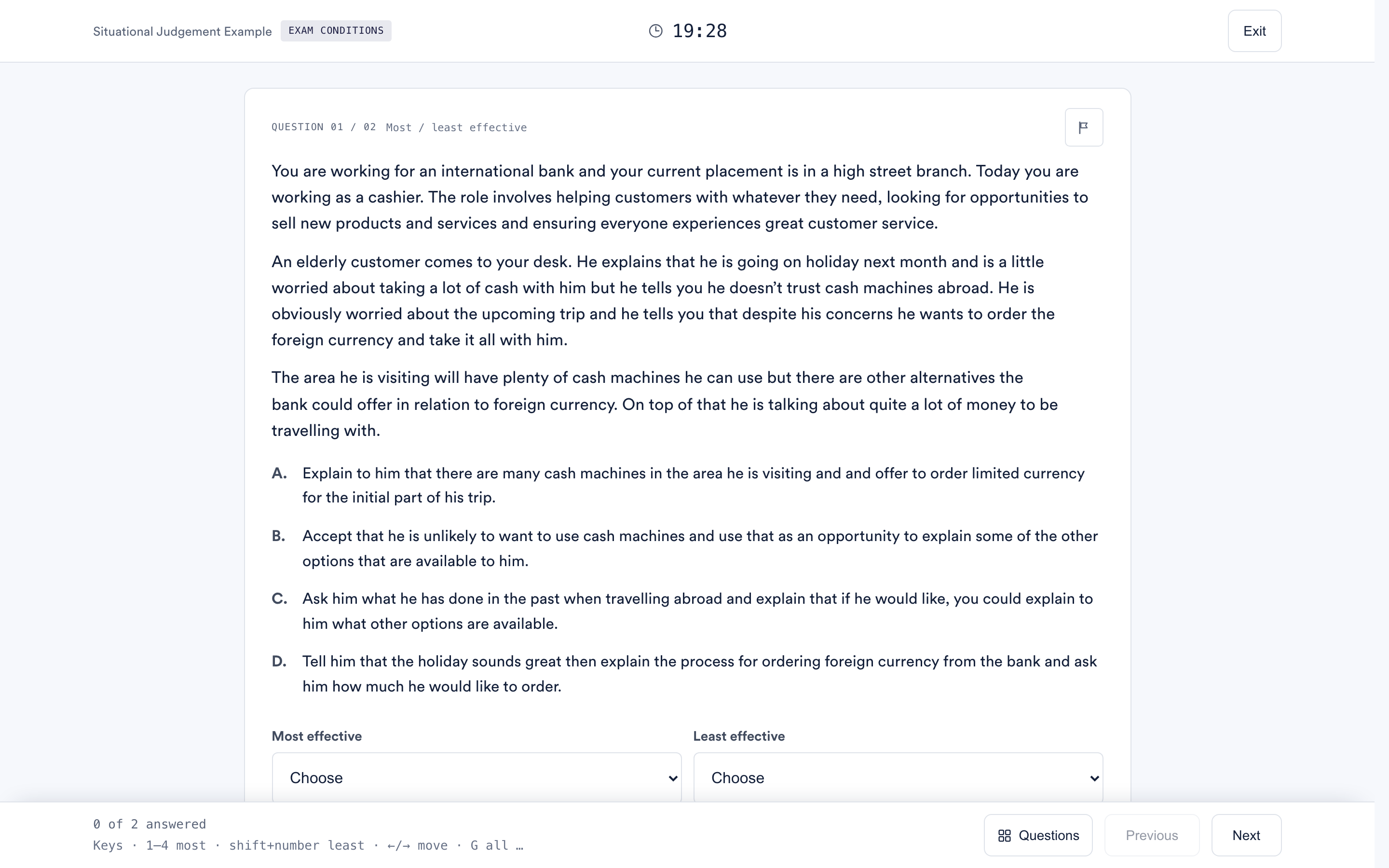
Every soft skills test is a situational judgement test. The candidate is shown a realistic work situation and asked how they would respond.
What the soft skills range covers
Tests on accountability, adaptability, communication, competitiveness, compliance and ethics, customer service, decision-making, emotional intelligence, interpersonal skills, leadership, management, negotiation, problem solving, project management, remote work, strategic thinking, teamwork and time management, plus a general situational judgement test.
What they measure
Judgement about what to do, in the kind of situation the role puts people in. They are closer to a structured interview question than to an aptitude test.
They are the right choice when the risk in a role is not "can they do the work" but "how will they handle it when it goes wrong": a customer-facing role, a first management job, a role with compliance obligations.
Why they are misread
Two ways, both common.
Treating a low score as a character judgement. It is not. It is how a candidate answered a handful of hypothetical situations in a few minutes. People answer scenarios differently from how they act, in both directions.
Assuming there is one obviously right answer. The options are written so that more than one is defensible and the differences are matters of degree. A candidate who thinks carefully can score below one who answers on instinct.
Using soft skills tests well
- Pick one that matches a real demand of the role, not one that sounds nice. "Accountability" is on every job advert ever written; only add it if you can say what you would do with a low score.
- Use the result as interview material. The test's guide includes a follow-up question, and asking a candidate to talk through a real example beats the score every time.
- Do not stack three of them. They overlap heavily and a candidate sitting three scenario tests in a row starts pattern-matching rather than thinking.
Reading a score
A percentage, like the cognitive ability tests, with a test average to compare against. The same caution applies: it is evidence about judgement in these scenarios, not a prediction of behaviour.
What candidates are told
Situational judgement in the candidate help centre, which explains the format and tells them to answer as they would actually behave.