Tests on the software people actually use at work: spreadsheets and documents, design tools, analytics, advertising, CRM and commerce.
What the software range covers
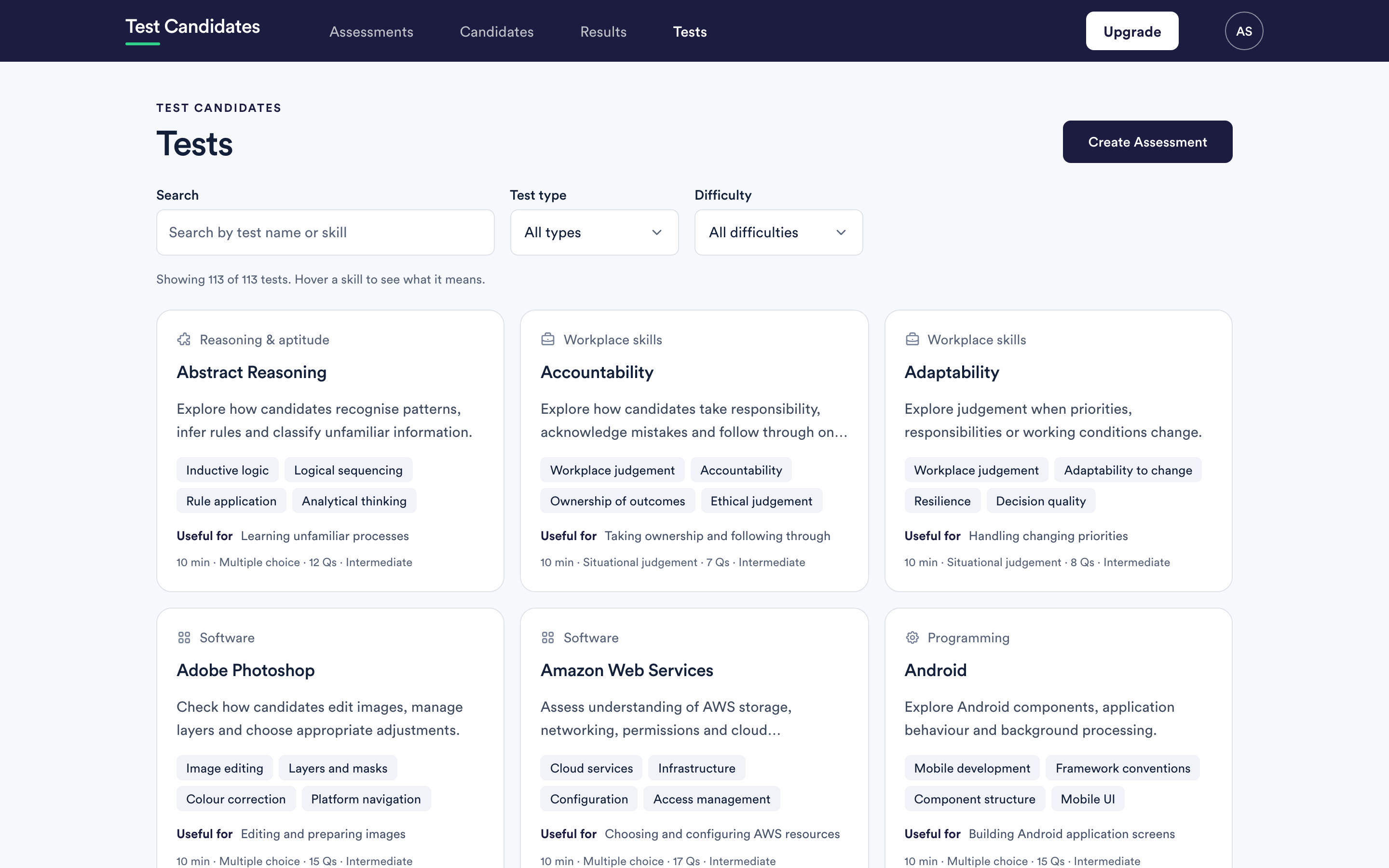
Microsoft Excel, Word and PowerPoint. Google Analytics, Google Ads and Facebook Ads. Tableau, Power BI, SAS and Elasticsearch. Salesforce, HubSpot and Jira. Shopify, WooCommerce, QuickBooks, AutoCAD, Adobe Photoshop and Redis.
Cloud platforms and developer tools, such as Amazon Web Services, Docker and Git, are in the coding tests.
Like the coding tests, these are multiple choice. Candidates answer questions about the tool; they do not open it.
When a tool test is the right choice
When the role spends real time in a specific tool and a gap would cost you in the first month. A finance role that lives in spreadsheets, a marketing role that reports out of an analytics tool, an operations role in a particular CRM.
It is a more direct question than a reasoning test, and candidates find it fairer, because it is obviously about the job.
When a software test is the wrong choice
When the tool is learnable in a fortnight. Testing for a CRM that any capable person will pick up quickly screens out good candidates for no gain.
When you are really testing for exposure. Someone who has never had a licence for an expensive tool has not had the chance to learn it. If the role can teach it, test the underlying skill instead.
When the version matters. Tools change. A test cannot track every release, and a candidate who learned last year's interface is not less capable.
Excel in particular
The most used software test and the easiest to over-read. It asks about functions and behaviour, not about building a model. A strong score tells you someone knows their way around the tool. It does not tell you they can structure an analysis, and those are different people surprisingly often.
Keeping a software test fair
- Say in the job advert which tools you will test. Candidates can then decide whether to apply, and nobody is ambushed.
- Pick the one or two tools the job really needs.
- If a tool is genuinely essential, set the difficulty to match the standard you need rather than the hardest available.
Reading a score
A percentage, with a test average from everyone who has taken it. Same caution as everywhere: it is evidence about knowledge of that tool, not about the person's general capability. See scores, averages and rank.