You are going to be asked about this, by candidates and by your own colleagues. Here is the honest version, which is also the version the product uses.
Where questions come from
Tests are written to a defined specification for each skill: what it should measure, what the format is, how many questions and how long candidates get. Every test carries the skills it measures, named and defined, on its own guide page.
Question content is reviewed before a test is published and reviewed again when something is reported. If you find a question you believe is wrong or unfair, email support@testcandidates.com with the test and what you saw. That is the fastest route to a fix and it is genuinely used.
What the difficulty label means
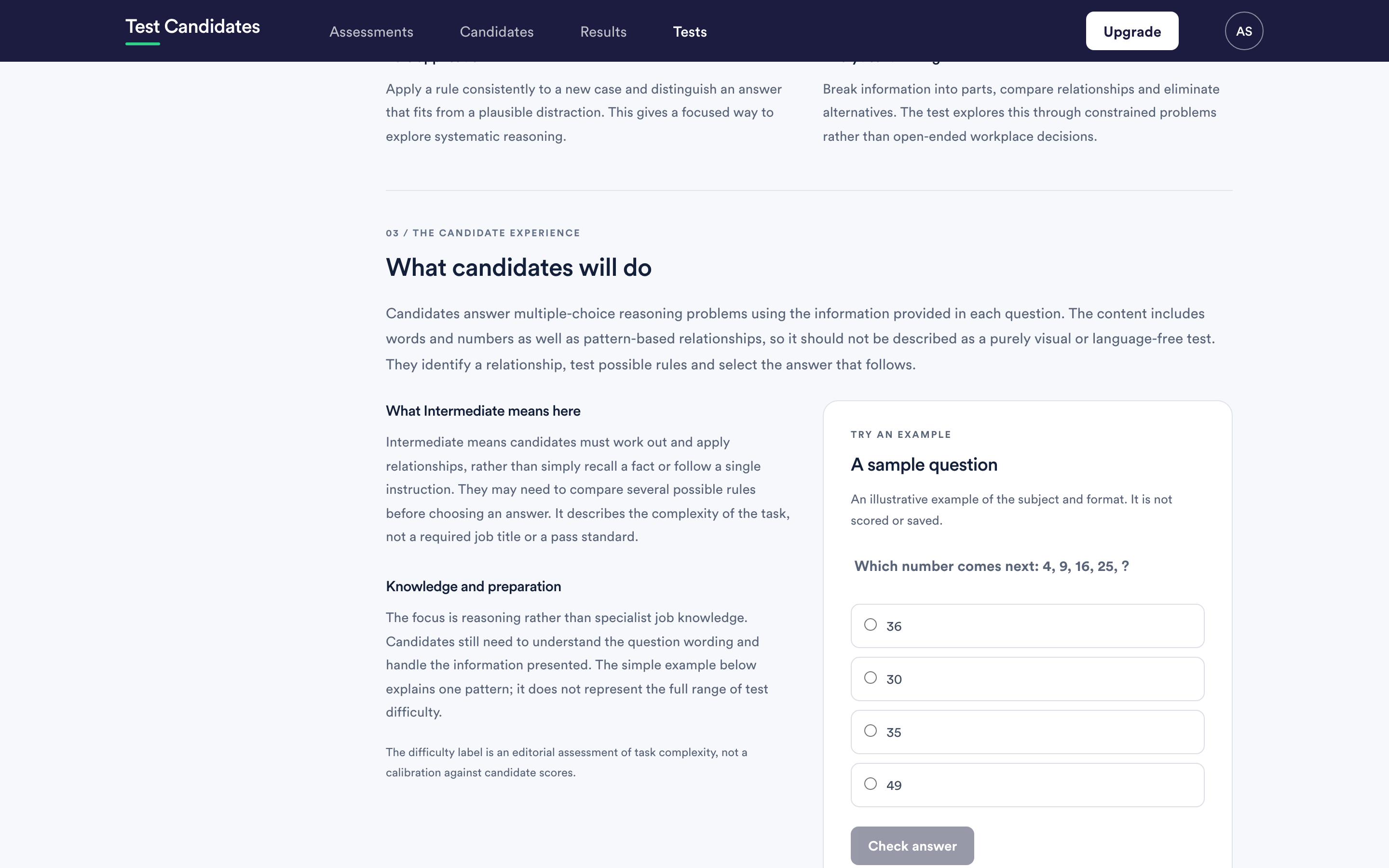
It is an editorial assessment of task complexity, not a calibration against candidate scores. The product states that on every test guide, and it is worth repeating because it is easy to assume otherwise.
Foundation, Intermediate and Advanced describe how much work the task takes: how many steps, how much has to be held at once, how much structure is given. They are not derived from how candidates performed and they do not set a standard.
What the test average means
Library tests show an average score across everyone who has taken them with us. It is a real observation, and it is the only outside reference point in the product.
It is not a national norm, a benchmark against your industry, or a validated comparison group. It is the people who have taken this test here.
Custom tests you write have no average, because only your candidates have taken them.
What we do not claim
We do not claim that a score predicts job performance in your company. We do not publish validity coefficients, adverse impact studies or norm groups, and you should not assume any exist behind the scenes.
Every test guide says what a stronger score supports and, in the same words each time, what it does not establish: technical competence, creativity, communication skills or likely job performance are not established by a score.
Why the reports are worded that way
Because it is what the evidence supports, and because over-claiming would set you up to fail. If you tell a candidate that a test predicts success in the role, you have made a promise you cannot defend when they ask how. If you tell them it is one consistent piece of evidence used alongside an interview, you have said something true.
Using the tests defensibly
- Decide what the role requires before you choose tests.
- Use the same assessment for every candidate for that role.
- Record the decision and why. See record a decision and a team note.
- Offer adjustments, and say that you offer them. See timing, extra time and adjustments.
- Never make a score the whole decision.