The honest answer
Yes, some will. An unsupervised online test can be taken with a second device beside you, with someone else in the room, or by someone else entirely. No remote testing tool can prevent that, and any that says it can is overselling.
What you can do is make it less attractive, notice some of it, and design a process that does not hang on the test alone.
What the integrity checks do
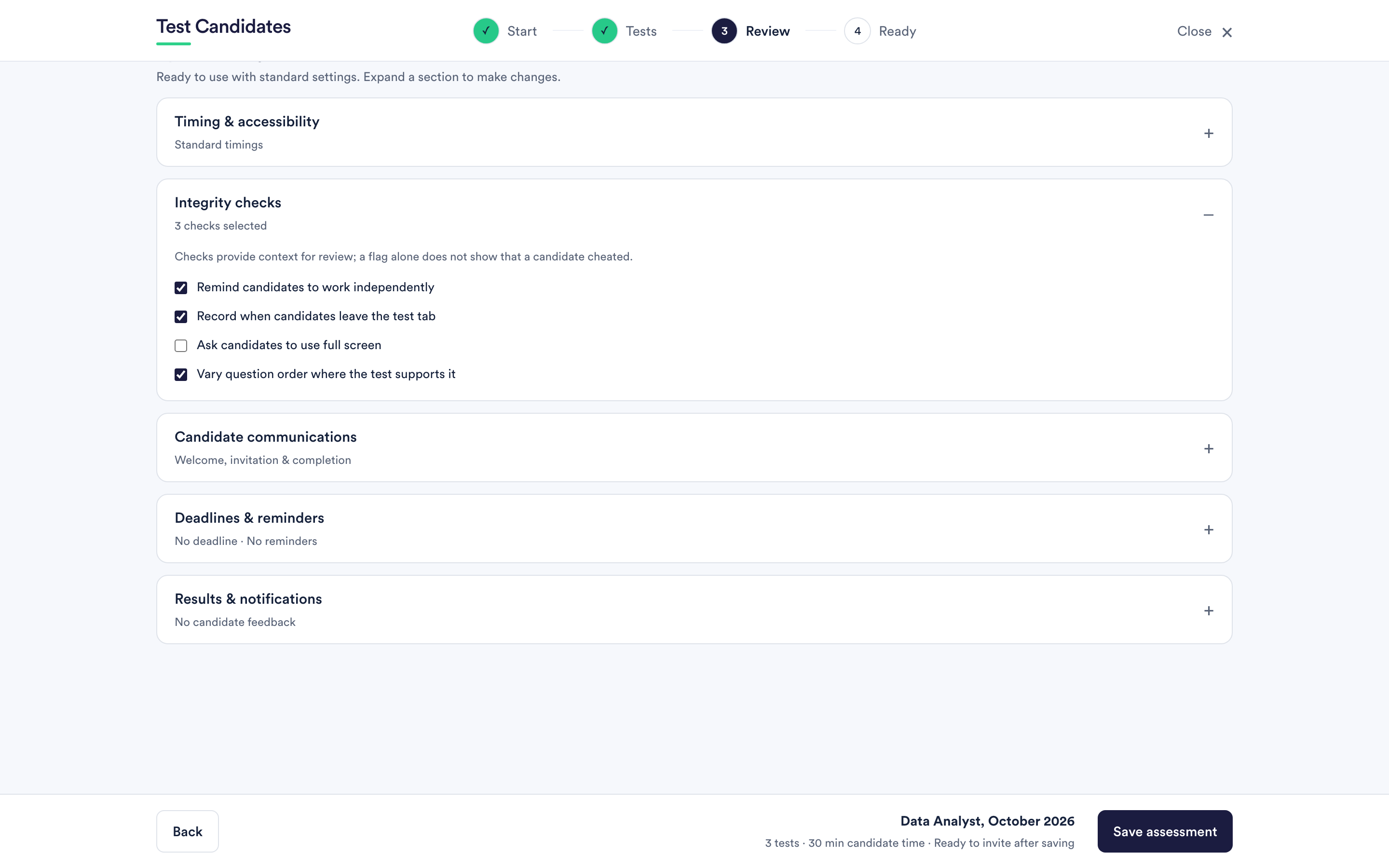
Four optional checks, covered in integrity checks:
- a reminder to work independently,
- recording when the test tab loses focus,
- asking candidates to use full screen,
- varying question order where the test supports it.
The product's own words on that panel: checks provide context for review, and a flag alone does not show that a candidate cheated. Take that literally. A candidate who left the tab may have had a notification, answered the door, or opened a calculator.
What you actually see afterwards
An Integrity checks panel on each candidate's report: mouse exits, tab hidden periods, full-screen exits, copy attempts, leaving the test window, IP changes and more, counted across the assessment, with any warning signs and what to ask about them. It says plainly that these checks flag things worth asking about and are not proof on their own. A check can miss an event, for example on a device that does not report it, so no flag does not mean nothing happened.
That is the right way to read the whole feature.
What they do not do
No camera. No identity verification. No detection of a second device, a second person, or a search in another browser. No lockdown of the candidate's machine.
What actually reduces cheating
The reminder. Asking people to be honest at the moment it matters changes behaviour more reliably than surveillance does. It is the cheapest check and the most effective.
Keeping the stakes proportionate. An assessment presented as a filter that decides everything invites cheating. One presented as one input among several does not.
Question variation, where a test supports it, which makes sharing answers less useful.
A conversation afterwards. A candidate who did not do their own test cannot talk about it. Asking someone to walk you through how they approached a question they scored well on takes two minutes and is the single most effective check available to you.
Reading a report for signs
The every answer in order chart shows time on screen per question. Unusually uniform timing on a hard test, or a strong score with implausibly short times, is worth a question. It is not proof.
Judge it against the other tests in the assessment too. A candidate who is exceptional on one test and ordinary on the rest is worth asking about.
If you suspect someone
- Do not accuse. Ask. "Talk me through how you approached the second question" is fair and informative.
- Apply the same standard to everyone. Looking for flags only on candidates you already doubted turns the checks into confirmation of your prior view.
- Record what you did, in the team note.
Designing an assessment around it
If a role genuinely cannot tolerate any doubt about who did the work, the answer is a supervised stage later on: a live exercise, a pairing session, or a structured interview about the same material. Use the online assessment to decide who gets that hour, not to decide the hire.
What candidates are told
The candidate help centre asks them to complete the assessment independently and explains why. It does not threaten them, because that does not work.